
Ring Circuits - Socket Outlets
 A ring circuit starts in the same way as a radial, but a cable from the last socket outlet connects back to the consumer unit. All of the socket outlets have two cables connected to them, and there is no 'end'.
These are very common in UK dwellings. They are a useful way of saving cable, since the cables can be smaller than an equivalent radial, with both cables sharing the load.
The main problem is when the ring is broken, either by loose connections or someone making incorrect modifications to the circuit. This can lead to the cable being overloaded, as all of the socket outlets will continue to function normally but will only be supplied by a single cable. This also makes fault finding more difficult.
Older installations may have a single ring circuit covering the whole house. The usual method today is one circuit for each floor of the property, and possibly a separate one for the kitchen or utility room.
Socket Wiring
As described previously, a ring circuit starts at the consumer unit, connects to each socket outlet in turn, and then returns to the consumer unit. All of the socket outlets will have two cables.
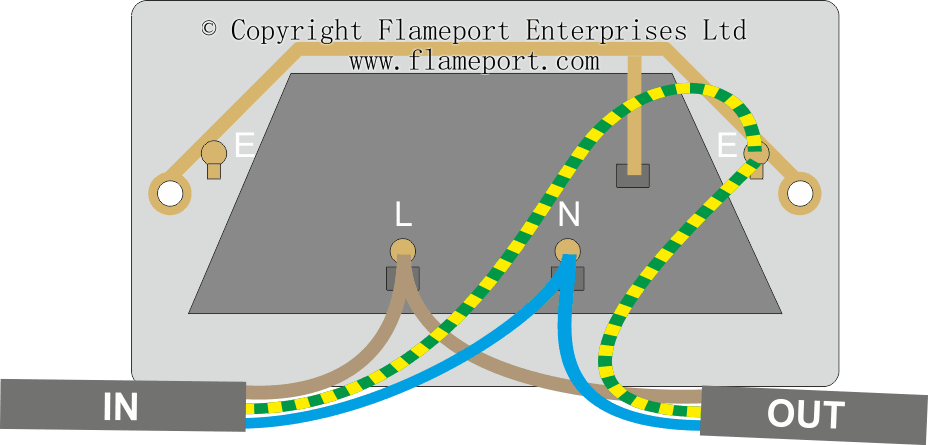 Wiring is the same as for the radial circuit. Both brown wires connect to the Live or L terminal. Both blue wires connect to the Neutral or N terminal. The earth wires will be bare copper, and should have some green/yellow stripe sleeving placed over them. Both earth wires connect to the Earth or E terminal.
If the socket outlet has two earth terminals, either one can be used. Two terminals are used when high integrity earthing is required - not something normally used in domestic properties.
Old colour socket wiring
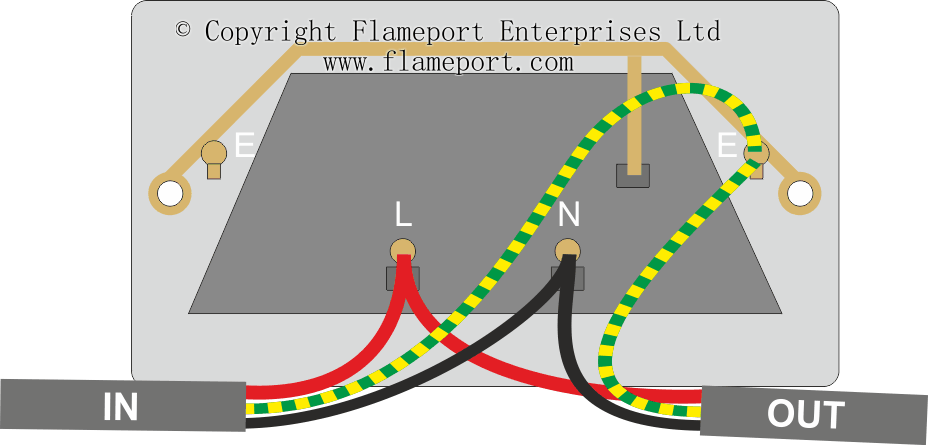 Older circuits will have red for the live wire and black for the neutral wire. The earth is usually sleeved with yellow/green stripe. Solid green sleeving indicates an older installation from 30+ years ago.
Connecting wires
When connecting the two wires into the terminal, do NOT twist them together. This can make the copper wire brittle, and also makes subsequent testing of the circuit far more difficult.
The terminal screw should hold both wires securely without the need for twisting. If the socket outlet has particularly large terminals, fold the end of each wire over using a pair of pliers before inserting it into the terminal. This will give the screw more metal to grip.
Other names
Ring circuits, or ring final circuits, are often incorrectly called 'ring mains'. A ring main is used in the distribution network and there is likely to be one buried outside under the road.

